
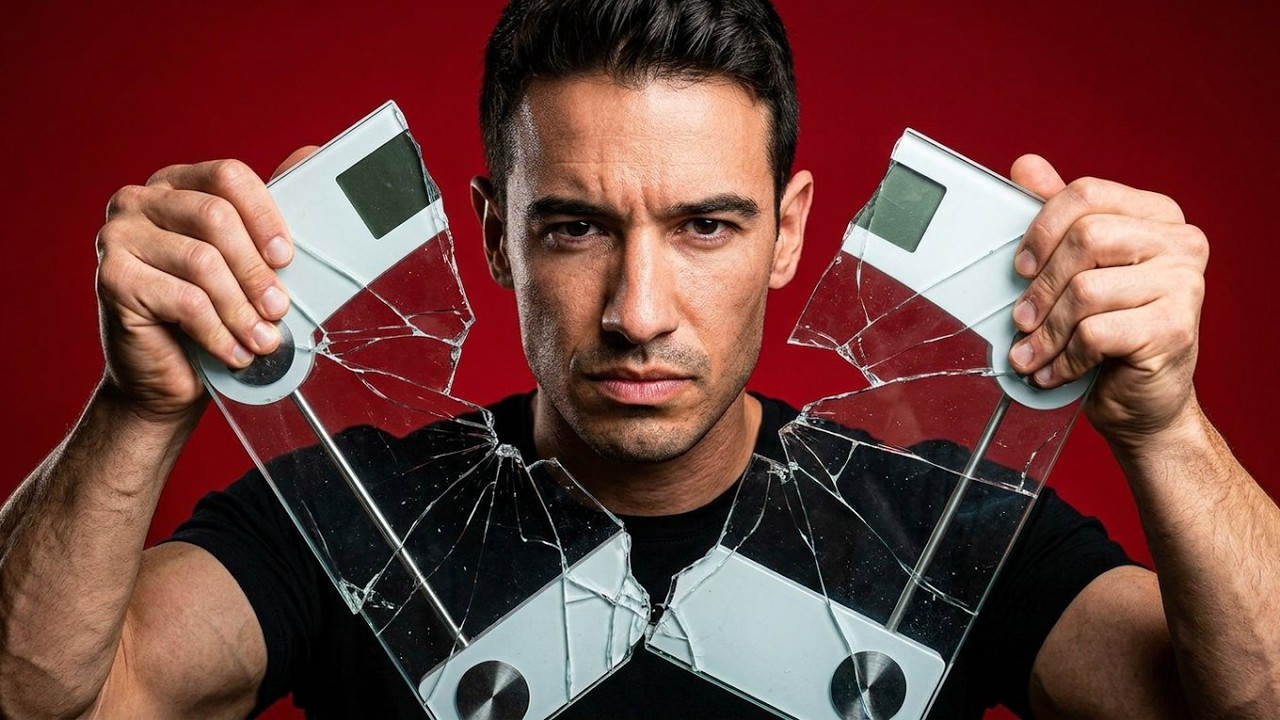
You're over 40, you've been eating less and moving more, and the scale still isn't cooperating. Maybe you lose a few pounds, then stall. Maybe you lose them and gain them back within months. Maybe you're doing everything you were told and feel like your body is working against you.
Here's what I tell every client in this situation: stop trying to lose weight. That's not a joke. Weight loss is the wrong goal, and chasing it with conventional methods after 40 is one of the main reasons people stay stuck. Let me explain exactly what's happening and what to do instead.
The Scale Is Lying to You
Weight is not fat. This sounds obvious, but the implications run deeper than most people realize. Your weight on any given morning reflects fat mass, muscle mass, organ weight, bone, water retention, food currently in your digestive system, and more. Some of those components are stable. Some fluctuate daily. Only two change meaningfully over months of effort: fat mass and muscle mass.
When you lose 10 lbs, that number tells you nothing about where those pounds came from. Lose them quickly through aggressive restriction and cardio, and a large portion will come from muscle. Lose them slowly with the right approach, and you can protect and even build muscle while the fat comes off. The scale shows the same number either way. I've had clients hit the exact same 10 lb loss twice in their life and look completely different at the end of it, because of where those pounds actually came from.
Weight loss is not synonymous with fat loss. Chasing the number on the scale without protecting muscle is one of the most common ways people make their situation harder over time.
What's Actually Happening in Your Body After 40
Starting around age 30, the body begins losing muscle at a rate of roughly 3 to 8% per decade. That sounds modest, but if you're in your 40s or 50s and haven't been actively building muscle, you've likely lost 10 to 25% of your muscle mass compared to your peak. That loss has a direct effect on your metabolism.
Muscle is metabolically active tissue, meaning it burns calories at rest. More muscle means a higher resting metabolic rate. Two people who weigh the same can have very different metabolisms depending on how much of that weight is muscle versus fat. The leaner person burns more calories doing nothing, which means they can eat more food to maintain their physique over time.
Here's what the research actually shows: metabolism does not meaningfully slow down between ages 20 and the mid-60s. What changes is how much muscle people carry. I tell clients this constantly because it reframes the entire problem: if your metabolism feels slower now than it did at 35, it almost certainly isn't your age doing that. It's the muscle you've lost. And that's actually good news, because muscle loss is reversible.
This is also why the strategies that worked in your 30s, eating a little less, adding some cardio, don't work the same way now. The physiological environment is different. Your body is less primed to respond to those levers. The approach has to change.
Why Eating Less and Doing More Cardio Makes It Worse
Standard weight loss advice is: cut more calories, do more cardio. And technically, yes, you'll lose weight. But here's what actually happens when you do this after 40.
First, large calorie deficits accelerate muscle loss. The bigger the deficit, the higher the proportion of weight you lose that comes from muscle rather than fat. Losing 10 lbs at a moderate deficit looks very different in terms of body composition than losing 10 lbs through aggressive restriction.
Second, chronic undereating makes it nearly impossible to hit adequate protein and micronutrient intake. Protein is the primary dietary signal for muscle retention and growth. Vitamins and minerals like magnesium and vitamin D play critical roles in hormone function and how your body responds to training. Cut too aggressively, and both suffer.
Third, cardio doesn't build muscle. It's genuinely valuable for cardiovascular health and does burn some calories, but it does almost nothing to improve body composition on its own. If your primary exercise tool is cardio and you're not resistance training, you are burning calories while doing nothing to address the underlying muscle loss driving your slower metabolism.
The result: you lose weight, feel worse, struggle to maintain it, rebound, and end up in a harder position than when you started. I've seen this cycle play out with almost every client who came to me still following advice built for their 30s. This isn't a failure of discipline. It's a predictable outcome of using the wrong strategy.
The Two Levers That Actually Work
The goal shifts from weight loss to body composition improvement: maximize fat loss, protect and build muscle. Two levers drive that outcome.
Lever 1: Resistance Training Done Right
Lifting weights has to be the primary form of exercise, not cardio. Two to three full-body strength training sessions per week, hitting every major muscle group at least twice, is the foundation. This is the structure I put every client over 40 on, regardless of their starting point. Cardio can sit on top of that if you want the cardiovascular benefits, but it's not the engine.
The variables that actually determine whether your training builds muscle:
Lever 2: Nutrition That Supports the Goal
Nutrition after 40 isn't about eating as little as possible. It's about eating in a way that supports muscle while creating a modest fat loss environment.
Two things matter most. First, protein: at minimum 0.8 grams per pound of body weight per day, consistently. At 200 lbs, that's 160 grams of protein daily. This is the single most important nutritional lever for preserving muscle while in a deficit.
Second, calorie deficit: modest, not aggressive. A rate of weight loss around 0.5% of body weight per week is the sweet spot. At that pace, fat comes off steadily, the scale moves in the right direction, and muscle retention stays high enough to actually improve your body composition rather than just making you a smaller version of the same problem.
At 200 lbs, that's roughly 1 lb per week. At 150 lbs, it's closer to 0.75 lbs per week. The percentage-based target is more accurate than a flat number because body size changes how meaningful that loss actually is. Crash dieting always backfires. The slower, more patient approach produces better results and keeps them.
- Weight loss is the wrong goal after 40. The right goal is improving body composition: lose fat, preserve or build muscle.
- Metabolism doesn't slow down with age. It slows because of muscle loss, which starts around 30 and compounds without active resistance training.
- Aggressive calorie restriction and cardio-focused exercise accelerates muscle loss, slows metabolism further, and sets up the yo-yo cycle.
- Lever one: 2 to 3 resistance training sessions per week, training with real intensity, progressive overload, full range of motion, and sufficient volume.
- Lever two: at least 0.8 g of protein per pound of bodyweight daily, and a modest deficit targeting around 0.5% of body weight loss per week.
The shift from "lose weight" to "improve body composition" isn't just semantic. It changes every decision you make about how you train and eat, and it's the difference between a strategy that produces lasting results and one that keeps you stuck in the same cycle. After 40, the margin for doing it wrong gets smaller. But doing it right is absolutely achievable, and the results compound over time in a way that makes you look and feel better every year, not worse.
Build the Body You Want After 40
We work one-on-one with busy professionals to build personalized training and nutrition plans focused on real body composition change, not just the scale. Apply and let's talk about what's possible for you.
Apply Now →