
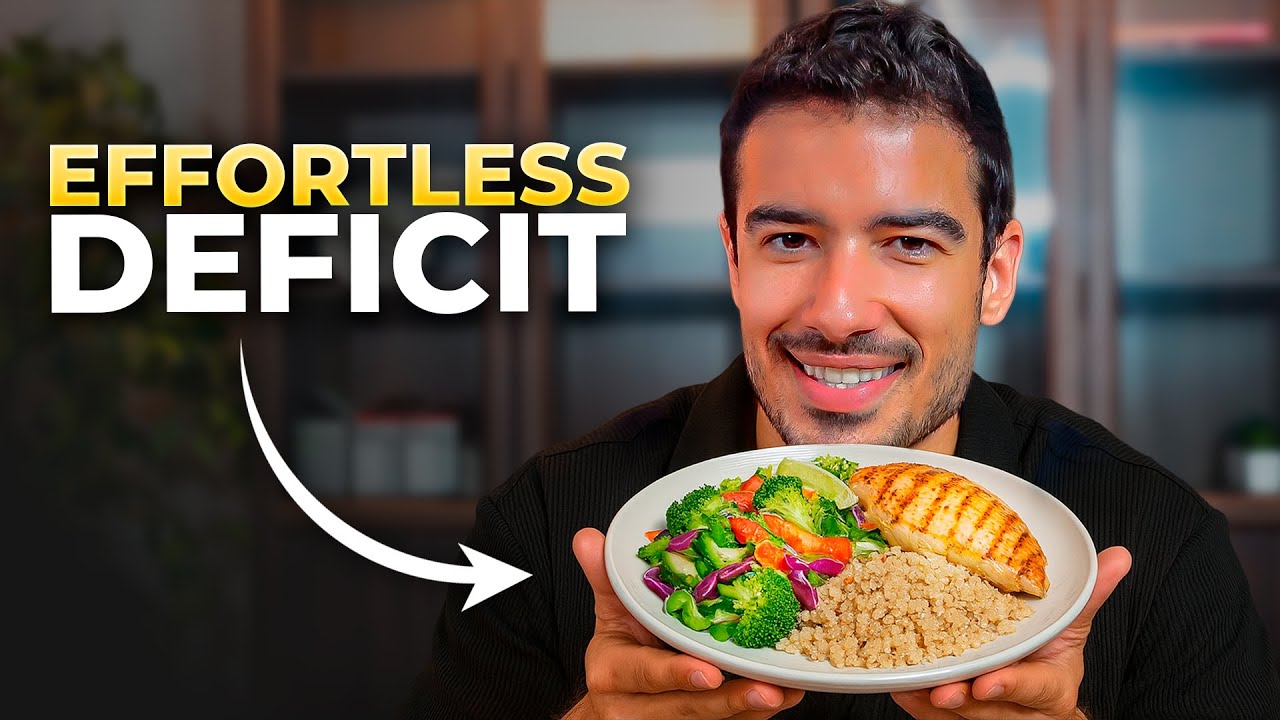
I hear this all the time: someone tracked their food, cut their portions, and held it together for a week or two. Then hunger caught up, the cravings got louder, and they gave in. They told themselves they lacked discipline. They were wrong. They just did it the hard way.
A calorie deficit feels easier when you cut liquid calories, favor whole foods over processed ones, and protect your sleep. All three change how full you feel at the same calorie level, without requiring more willpower.
A calorie deficit doesn't have to feel like a constant battle. The difference between people who lose fat and keep it off versus those who quit isn't willpower. It's strategy. Specifically, it's how they structure their diet so their body isn't working against them every hour of the day.
There are three concrete changes I recommend that make staying in a deficit dramatically easier. Two are about what you eat. One is about something most people never think to connect to fat loss at all.
Why Your Deficit Feels So Hard Right Now
If you're hungry all the time on a deficit, you're probably doing one of two things: eating the same foods as before but in smaller quantities, or burning extra calories through cardio to compensate for a diet that hasn't changed. Both approaches fail for the same reason: they fight hunger without doing anything to actually reduce it.
Hunger isn't just about calories. It's about how full your stomach feels, how long food keeps you satisfied, and whether your body has what it needs to regulate appetite in the first place. If someone only cuts portions without changing food quality, the body registers it's getting less food and signals hunger accordingly. You can white-knuckle that for a while. Nobody wins that fight long-term.
The good news is that it's possible to be in the exact same caloric deficit and feel completely different depending on what you eat and how you sleep. That's not a motivational statement. It's physiology, and the research backs it up.
Step 1: Eliminate Liquid Calories Completely
The simplest change you can make, and the one with the highest immediate return, is removing calories you drink. Juice, sweetened coffee drinks, soda, alcohol. These add a significant amount of calories to your day while doing almost nothing to reduce hunger.
The reason is straightforward. Satiety, the feeling of fullness that makes you stop eating, comes largely from physical volume in your stomach, from chewing, and from the fiber and protein content of food. Liquid calories deliver none of that. A large glass of orange juice can have 200 to 300 calories and leave you exactly as hungry as a glass of water.
- Fruit juice (even 100% natural)
- Sweetened Starbucks drinks
- Soda and energy drinks
- Alcohol (7 cal/g, more than sugar)
- Smoothies with added fruit
- Black coffee or coffee with stevia
- Zero-calorie sodas (Coke Zero, etc.)
- Sparkling water
- Plain tea, hot or cold
- Water with lemon or electrolytes
Alcohol is worth a specific mention because most people underestimate how calorie-dense it is. At 7 calories per gram, alcohol is almost twice as dense as carbohydrates or protein. A mixed drink with juice can easily hit 250 calories, and it does nothing for satiety. One drink often becomes two or three, and now you've consumed the equivalent of a full meal in calories without feeling any fuller than when you started.
One note on zero-calorie sweeteners: the concerns around artificial sweeteners like aspartame are significantly overstated. The human data at the quantities people actually consume shows no meaningful negative health impact. More importantly, research shows that people who use artificially sweetened beverages are more likely to maintain fat loss long-term, likely because they satisfy sweet cravings without adding calories. Swapping your soda for a zero-calorie version is a net positive, not a health risk.
Step 2: Prioritize Whole Foods Over Processed Ones
This is where the research gets genuinely surprising. Most people assume that as long as calories and macros match, it doesn't matter whether food is processed or whole. A study published in Cell Metabolism in 2019 by Dr. Kevin Hall showed that assumption is wrong in a significant way.
Participants spent 14 days eating either a whole foods diet or an ultra-processed diet. Both diets were matched on total calories, caloric density, macronutrients, sodium, fiber, and micronutrients. On paper, the two diets were identical. The only real difference was the degree of processing. Participants were allowed to eat as much as they wanted and were in a controlled metabolic ward for the full two weeks.
Those on the ultra-processed diet ate an average of 400 extra calories per day, gained about two pounds over the two weeks, while those on the whole food diet lost about two pounds over the same period.
Four hundred extra calories per day, with no increase in hunger relative to the whole foods group. The reason is that hunger regulation doesn't operate purely on calorie content. The texture, the need to chew, the fiber content, the way food moves through your digestive system: all of these affect how full you feel and for how long. Highly processed foods are easier to overeat precisely because they've been engineered to go down easily. A whole potato satisfies you differently than the same calories in potato chips, even when the numbers match on a label.
In practical terms: choose an actual chicken breast over a protein bar when you can. Eat whole fruit instead of fruit juice. Have rice or a potato with your meal instead of processed crackers. These swaps don't require tracking anything. They just work at a biological level your calorie app can't capture.
Step 3: Protect Your Sleep Like It's Part of Your Diet
This is the one most people miss entirely. Sleep is not a recovery tool that sits alongside your nutrition plan. For someone in a calorie deficit, sleep quality directly determines how hungry you are and how many calories you burn. Get this wrong and your deficit becomes dramatically harder to maintain, regardless of how disciplined your food choices are.
Poor sleep raises ghrelin, which is the hormone that signals hunger. Higher ghrelin doesn't just make you feel vaguely peckish. It specifically increases cravings for calorie-dense, processed foods. At the same time, sleep restriction reduces energy expenditure because you move less when you're tired. You don't have to run less. You just fidget less, take fewer steps, and generally move through your day with less energy. The result is a two-sided problem: you burn fewer calories and feel hungrier at the same time.
A 2013 study gave that number a concrete figure. Participants who were sleep-restricted to around 5.2 hours per night consumed an average of 559 extra calories per day compared to the group sleeping 8 hours, with no increase in energy expenditure. If you're already trying to maintain a 500-calorie deficit to lose roughly a pound a week, poor sleep can completely erase that deficit and then some before you've even made a single food choice.
You can't always control your sleep perfectly. Kids, work, stress: life gets in the way. But you can control the conditions that give your sleep the best chance. A consistent bedtime and wake time matters more than almost anything else. A cold, dark room. No screens or stimulating content in the hour before bed. These aren't minor optimizations. For someone on a calorie deficit, they're as important as the food decisions you're making during the day.
- Hunger on a deficit is usually a strategy problem, not a willpower problem. The right food choices make satiety much easier to maintain.
- Liquid calories add to your intake without contributing to fullness. Eliminating them is the highest-leverage nutrition change you can make immediately.
- Whole foods trigger satiety signals that processed foods don't, even when the calories and macros are identical. This is well-established in research, not bro science.
- Poor sleep can add 400 to 500+ calories of net intake per day by raising hunger hormones and lowering energy expenditure simultaneously.
- These three changes work together. Someone who eliminates liquid calories, eats mostly whole foods, and sleeps 8 hours is operating in a completely different metabolic environment than someone doing none of those things.
Fat loss doesn't require suffering. It requires building a version of a calorie deficit that your body and your habits can actually sustain. Most people fail not because the goal was wrong but because the approach made it harder than it needed to be. Fix the strategy, and the execution becomes manageable.
Frequently Asked Questions
Do diet sodas and artificial sweeteners actually help with weight loss?
They can. The health concerns around sweeteners like aspartame are significantly overstated at the amounts people actually consume. Research shows people who use artificially sweetened drinks are more likely to maintain fat loss long-term, likely because they satisfy sweet cravings without adding calories.
Can I still lose fat eating processed food if my calories are on point?
You can, but it will likely feel harder. A controlled study matching whole food and ultra-processed diets on calories, macros, and fiber still found participants ate 400 more calories a day on the processed diet without feeling any fuller. The processing itself, not just the nutrition label, affects how much you naturally eat.
How much does poor sleep actually affect a calorie deficit?
More than most people expect. One study found sleep-restricted participants ate about 559 extra calories a day compared to those sleeping 8 hours, with no increase in activity to offset it. That's enough to erase a typical 500-calorie deficit entirely.
Which should I fix first: liquid calories, food quality, or sleep?
Start with liquid calories since it's the fastest, lowest-effort change with an immediate return. Whole food swaps and sleep habits take longer to build but compound with that first change rather than replacing it.
Tired of Starting Over Every Few Months?
We build fat loss plans around your actual life, not an ideal one. Whole foods, sustainable habits, and a strategy you can stick to long-term.
Apply Now →